


Toyota Camry
To those of a particular generation, the Toyota Camry is the epitome of the four-door, mid-size sedan. The best-selling mid-size model has long appealed to budget-conscious families for its reliability, low running costs, spaciousness, and (in most versions) good fuel economy, but at the same time the Toyota Camry has never been very flamboyant or exciting to drive. Over time, the Toyota Camry has come to be thought of as a little too 'vanilla' for some tastes—comfortable, nevertheless.
Nevertheless, after decades, this nameplate remains solidly at the center of the mid-size sedan market. Alternatives to the Toyota Camry have included the Chevrolet Malibu, Ford Fusion, Honda Accord, Hyundai Sonata, and Nissan Altima, among many others.

Toyota Camry
Whether you buy a Toyota Camry from the 1990s or a brand-new one, you're getting a comfortable, spacious sedan that performs reasonably well but isn't downright sporty. In recent years, the Toyota Camry has kept to the same formula, but Toyota has upgraded safety and added desirable options like a navigation system, heated leather seats, and a smart key system.
The Toyota Camry first was introduced to the U.S. market as a front-wheel-drive replacement for the rear-wheel-drive Corona. Quite boxy and basic, that first Toyota Camry won over masses of U.S. buyers who, during that time, were reaching a critical point of frustration over the reliability and quality of domestic-brand cars.

Toyota Camry
Subsequent Toyota Camry models became a little larger, more refined, and more comfortable and luxurious with each generation. At the time the second-generation Camry made its debut for 1987, the Camry's 115-horsepower, 2.0-liter four-cylinder was quite technically advanced as it was one of the first engines in an affordable four-door sedan with four valves per cylinder. Wagon variants of the Toyota Camry were reasonably popular through this period, too, and a five-door hatchback version of the model was even sold through '86.

Toward the late '80s, Toyota added a V-6 option for the first time, and it began offering all-wheel drive (All-Trac) on some versions. That was the start of the Camry's movement slightly upscale, and for 1991, Toyota broke the U.S. Toyota Camry line away from the version made for its home market, recognizing that U.S. families wanted a larger product and aiming the model solidly at the same shoppers who at that time were considering the Ford Taurus. Toyota had, in 1988, begun assembling Camrys for the U.S. in Georgetown, Kentucky, where it's still produced today.

Two different U.S. Camry generations spanned the 1990s. Of those, the first (distinguished by rounded sheet metal and soft features) offered a tremendous leap in luxury over the previous model. The latter fourth-generation Toyota Camry was panned at launch for its especially bland styling (and the wagon was discontinued), but it was an even stronger seller. Through these two generations the Toyota Camry didn't make any tremendous advances, but its four-cylinder and V-6 engines grew in size and produced more power.

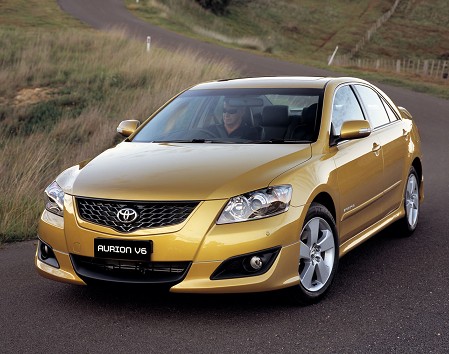
This past decade has seen two generations of the Toyota Camry. The previous generation, introduced for 2002, introduced a rounder look once again—this time making major advances inside with significantly upgraded materials—with a stronger 162-horsepower, 2.4-liter base engine. A 192-horsepower, 3.0-liter V-6 remained a popular option, and safety features were bolstered during this generation with the phasing-in of side airbags and stability control on some models.Then, for 2007, the Toyota Camry was redesigned again, with a smoother, less slab-sided look, much-improved safety and safety features, and an all-new 268-horsepower, 3.5-liter V-6 and six-speed automatic transmission at the top of the range. In this latest generation, a tighter suspension and upgraded wheels in the SE V-6 model brings a more sophisticated VDIM stability control system and a surprising level of responsiveness and performance satisfaction, if you can get past the bland appearance.

Also making its debut for 2007 was the Toyota Camry Hybrid, which paired a version of Toyota's Hybrid Synergy Drive (originally developed with the Prius) with an especially frugal version of the sedan's 2.4-liter four-cylinder engine. Altogether the system made 192 hp—the same as the V-6 a year or two before—but with gas-stingy EPA fuel economy figures of 33 mpg city, 34 highway.
For 2010, the base Toyota Camry got an even larger four-cylinder engine—a 2.5-liter, making 169 or 179 hp, while fuel economy was actually made better thanks to a new six-speed automatic transmission. A six-speed manual remained available on a limited basis with the four.
In 2012, the Toyota Camry was given a complete redesign, but from the outside the changes were so evolutionary that some might only see it as a mild refresh. Nevertheless, the 2012 Toyota Camry gets some substantial improvements to comfort, refinement, and handling. Gas mileage was also improved across the lineup (up to 25/35 for the four-cylinder), and a completely reworked Camry Hybrid—with an EPA city rating of up to 43 mpg—was the star of the lineup. Safety features were also substantially upgraded, with ten standard airbags, newly standard side rear thorax bags, and an improved structure, while Bluetooth hands-free connectivity was made standard on all models.




Courtesy By:


